The moment you configured
your platform, you stopped owning
your business logic.

Every platform asks the same thing: reshape how you operate to fit what we can express. So you did. The original logic, how your organization actually intends to work, was absorbed into the platform and locked there. It belongs to the vendor now. Migration means rebuilding from scratch. Every agent you deploy inherits a representation of your business that was never validated as yours.

Flowsiti inverts the premise. Define the operational blueprint first. Validate it. Keep it sovereign. Compile it to whatever platform needs to execute it. Your logic. Forever.

Not metaphorically. Flowsiti builds a validated, platform-independent representation of your business logic and generates a Deployment Manifest for each target system from it, following the same architectural pattern as any production compiler. The blueprint is the source. The platform is the target.

The Tension You Are Living

The opportunity is real.
So is the liability.

This is not an argument against agents or automation. Both outcomes, breakthrough and collapse, run on the same foundation. The quality of your business rules determines which one you get.

The Opportunity

Agents can transform how you operate at a scale previously impossible.

Decisions that took days execute in seconds across thousands of transactions simultaneously
Orchestration across entities, departments, and systems becomes programmable rather than procedural
The productivity case is real. The competitive pressure to move is real. Slowing down is not a strategy.
The Liability

Every agent executes the rules you give it. It does not know if they are correct.

A wrong rule executed by a human is one bad decision. The same rule executed by an agent is a systemic failure
Better models do not validate logic. They execute it faster. Speed on a flawed foundation amplifies the problem
Vertical agents, each correct in isolation, produce coherence failures when their unvalidated rules intersect

The market is racing to build faster execution. Nobody is asking what the execution is running on. Statistical models that infer from historical patterns are not organizational truth. When approximations become the foundation for autonomous decisions at scale, the gap between what systems infer and what the organization actually intends becomes the source of every failure nobody can trace.


What Flowsiti Is

The software that
learns your business
through an AI interface,
but executes with
mathematical certainty.

Flowsiti connects mid-stream to your existing reality. It does not require a clean slate. It ingests legacy systems, live configurations, documents, metadata, and tribal knowledge, any source, any format, any point in the lifecycle.

01
Admission Gate: bad input stops here
Before anything proceeds, every input is classified: structurally valid, incomplete but usable, or broken. Nothing ambiguous propagates downstream. The system is deterministic end to end.
02
Operational blueprint: formally proven
Your business rules compile into a platform-independent model verified against six constitutional principles. Contradictions are proven, not flagged. The blueprint is either valid or it is not.
03
Sovereign: yours forever
The blueprint never lives inside a vendor. Changing platforms is re-emission from the blueprint, not reconstruction of logic. You own the organizational DNA. The platform executes it.
04
DevOps-compliant outputs
Outputs fit directly into existing engineering workflows. No new delivery methodology imposed. The blueprint governs. Your teams build the way they already build.
Blueprint Canvas — Spatial Map
Flowsiti Blueprint Canvas showing spatial map, workflow nodes, and live validation panel
Your operational blueprint as a navigable spatial map. 74 nodes. Live validation panel surfacing 38 errors and 51 warnings before any deployment begins.
Baselines and Captures — Requirements Ledger
Flowsiti Baselines and Captures showing requirements ledger with coverage 100% and all nodes justified
Requirements baseline under review. Coverage 100%, all nodes justified. Every requirement traced, prioritized, and locked before deployment is authorized.
Immersive View — Hidden Tier Connections
Flowsiti 3D isometric view showing cross-tier dependencies, flow animation, and downstream impact analysis
67 nodes rendered across three tiers. Node #41 affects 8 downstream steps, 6 cross-tier. Hidden dependencies surface in three dimensions — invisible in every flat view.

The Processing Model

From any source
to every target.

Disparate inputs converge through the Admission Gate, compile into a platform-independent Blueprint Model, and emit to any number of target systems. The blueprint is the only artifact that persists. The adapters are interchangeable.

Flowsiti pipeline diagram showing inputs through admission gate to deployment manifest and targets

How It Works

Four stages.
One provable output.

The LLM is the interface. The kernel is the authority. No stage proceeds without the previous output being validated.

01
Intake
Admission Gate + LLM Interface

Any input, documents, configs, metadata, and legacy data, is admitted, classified, and structured. Structurally invalid inputs stop here with an explanation before the kernel ever sees them.

Bad input stops here. Always.
02
Design
Blueprint Compilation

Valid input compiles into a platform-independent operational blueprint. Business rules, authorities, sequences, and constraints formalized against the organizational primitive set.

Platform-agnostic. Owned by you.
03
Validate
Formal Verification Kernel

The blueprint is verified against six constitutional principles. Contradictions proven to exist as structural impossibilities, not detected by pattern matching. Invalid blueprints are rejected before any Deployment Manifest is generated.

Mathematical proof. Not heuristics.
04
Deploy
Deployment Manifest + Plan

The verified blueprint generates a Deployment Manifest, platform-specific, DevOps-compliant configuration artifacts, and a Deployment Plan that governs implementation. Changing platforms is re-emission from the same blueprint.

Salesforce · SAP · Agents · Custom.

The Validation Kernel

Six principles.
Every blueprint must
satisfy all of them.

These are not guidelines. They are formally verified constraints enforced before any Deployment Manifest is generated. A blueprint is either valid or it is not. There is no partial pass.

L1
Conservation

Every process path that opens must close. Every branch that splits must resolve. No agent can leave a transaction in an indeterminate state. No orphaned workflows, no lost data.

L2
Reachability

Every rule traces to its point of authority. Nothing executes without a verified connection to organizational intent. No rule operates in isolation or outside its defined scope.

L3
Membrane Discipline

Domain and entity boundaries are respected by design. Authority cannot leak across organizational lines. Cross-boundary interactions follow verified protocols, not tribal assumptions.

L4
Data Satisfaction

Every rule that reads data has a verified path to the source that writes it. No system, no agent, no workflow operates on data of unknown provenance or unverified origin.

L5
Evidence Integrity

Every rule carries its own provenance: where it came from, who defined it, what it depends on. The audit trail is constitutional. It is built into the blueprint, not appended after deployment.

L6
Composition Safety

Constitutional guarantees do not weaken as complexity grows. Rules composed from verified primitives inherit their properties. Scale does not corrupt the foundation.


The Kernel in Action

Any input.
Same rigorous output.

Five different input types. One validation kernel. Every structural violation found before deployment begins, regardless of how the logic arrived.

This is not analysis. This is accountability. These are structural failures proven to exist. Violations require conscious human acknowledgment before deployment proceeds. You can always choose to proceed. You can never proceed without knowing exactly what you are accepting.

01 · SOP Document
02 · Whiteboard
03 · Metadata
04 · Platform Flow
05 · Slack Thread
Input: Standard Operating Procedure — Corporate Client Onboarding
Document Reference
SOP-OPS-2024-0041
Version
v3.2 · Approved
Owner
Head of Client Operations
Last Reviewed
14 March 2024
Corporate Client Onboarding — Approval and Activation Procedure
1.0 · Purpose and Scope

Governs onboarding, approval, and activation of corporate clients over $500,000. Applies to Relationship Managers, Regional Directors, and Compliance Officers.

2.0 · Approval Requirements

Accounts over $500K require both Regional Director and Compliance sign-off prior to activation. Compliance approval is conditional on a completed KYC report. KYC reports are generated following account activation in the CRM.

3.0 · Post-Activation Communications

Upon activation, the welcome workflow initiates client-facing communications. Accounts under compliance review must not receive external communications.

4.0 · Expedited Pathway and Data

Regional Directors may approve without Compliance sign-off where the client holds a verified low-risk classification. Low-risk classification is assigned by the Compliance team. KYC reports use data from the activated CRM account record. The expedited pathway requires low-risk classification confirmed by Compliance before invocation.

Highlighted violations
L1 Conservation: circular dependency
L3 Membrane Discipline: boundary breach
L2 Reachability: unreachable bypass
L4 Data Satisfaction: missing write path
L5 Evidence Integrity: audit gap
Kernel output: 3 violations · 2 gaps
ViolationL1 · Conservation
Circular dependency — no valid start
Compliance requires KYC. KYC requires activation. Activation requires compliance. No valid process entry point exists. Every customer order will stall at onboarding.
This passes QA. It fails structurally.
ViolationL3 · Membrane Discipline
Communication boundary breach
Welcome workflow fires on activation and sends external communications. Compliance-pending rule prohibits contact. Both apply to the same event. Illegal communications will reach every newly activated account.
ViolationL2 · Reachability
Bypass is structurally unreachable
The bypass requires low-risk status. Low-risk status requires compliance action. The bypass is invoked when compliance has not acted. The enabling condition can never be true when the bypass is needed.
GapL4 · Data Satisfaction
KYC data source has no write path
KYC reads from the activated CRM record. The record does not exist when KYC must run. Agents will operate on data that cannot exist at execution time.
GapL5 · Evidence Integrity
Bypass audit trail absent
Low-risk classification enabling a compliance bypass has no defined record of who assigned it, when, or under what criteria. Any regulatory audit has no provenance to examine.
Sign-Off RequiredDeployment requires human sign-off
3 violations · 2 gaps
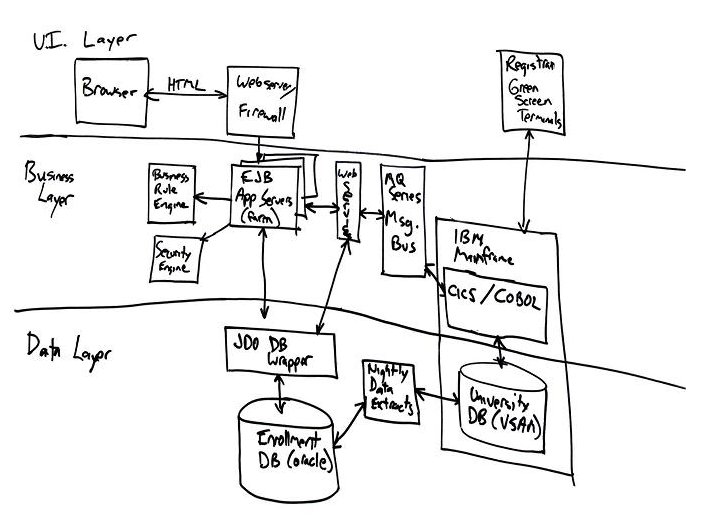
Input: Whiteboard diagram — three-layer enterprise architecture
architecture-whiteboard.jpg · Vision model parse
Hand-drawn whiteboard architecture diagram
Image parsed via vision model · 3 layers identified · 11 components extracted · 8 connections mapped · 3 ambiguous paths detected
Kernel output: 2 violations · 2 gaps
ViolationL4 · Data Satisfaction
Nightly Data Extracts creates unverified write path
University DB feeds Enrollment DB via Nightly Data Extracts but no synchronization protocol or failure handling is defined. Any business rule reading from Enrollment DB during a failed extract will operate on stale data with no detection mechanism.
ViolationL3 · Membrane Discipline
IBM Mainframe crosses layers without protocol
The IBM Mainframe connects directly to both the Business Layer and the Data Layer. No defined interface contract governs this cross-layer access. The mainframe operates across two domains with no membrane enforcement.
GapL2 · Reachability
Registrar terminals have no defined authority path
The Registrar terminal connects to the Business Layer but no authority chain or access control is shown. The terminal can reach business logic with no verified connection to organizational intent.
GapL5 · Evidence Integrity
Business Rule Engine has no audit trail defined
The Business Rule Engine has connections to the EJB App Servers but no logging, versioning, or provenance mechanism is defined. Rules executed cannot be traced to who defined them or under what authority.
Sign-Off RequiredDeployment requires human sign-off
2 violations · 2 gaps
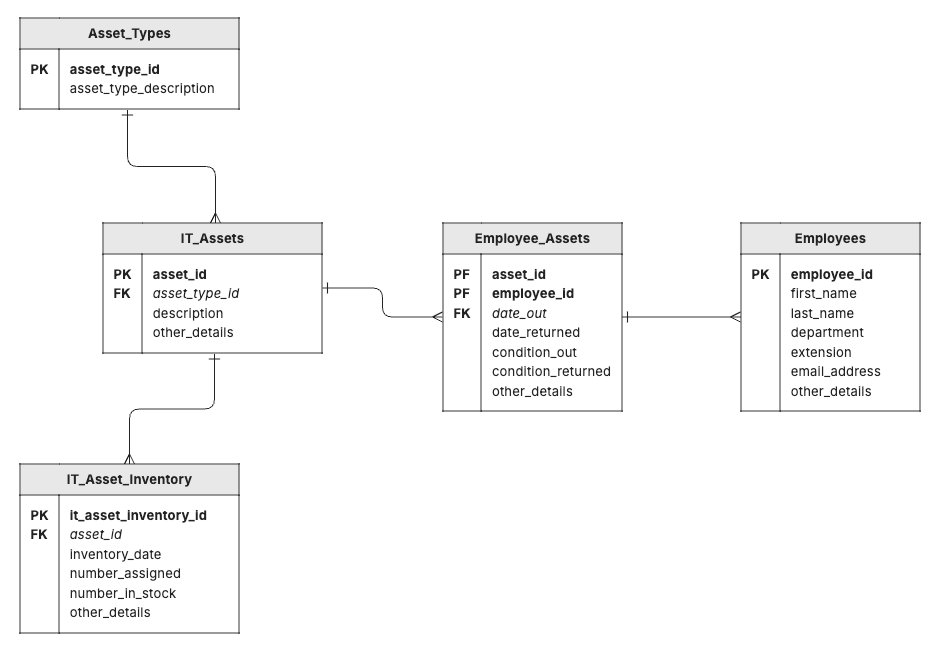
Input: Database schema — IT Asset Management
asset-management-schema.png · ERD import
Database schema ERD
4 tables parsed · 6 relationships extracted · 4 anomalies detected · Missing write paths and undefined retention flagged
Kernel output: 1 violation · 3 gaps
ViolationL4 · Data Satisfaction
Employee_Assets has no deletion path
Employee_Assets holds a FK reference to Employees but defines no cascade or nullify rule on employee departure. When an employee record is deleted, asset assignment records become orphaned with no valid owner.
GapL1 · Conservation
date_returned has no required constraint
Employee_Assets records condition_out on assignment but date_returned is nullable with no enforcement path. Asset return workflows can close without a return date. IT_Asset_Inventory counts will drift from actual asset state.
GapL3 · Membrane Discipline
IT_Asset_Inventory sync boundary undefined
IT_Asset_Inventory tracks number_assigned and number_in_stock but no defined trigger connects Employee_Assets assignment events to inventory updates. Inventory counts and assignment records can diverge silently.
GapL5 · Evidence Integrity
other_details fields carry no schema constraint
Four tables carry an other_details field with no defined type, format, or validation rule. Compliance reviews of asset condition or assignment history cannot rely on unstructured fields.
Sign-Off RequiredDeployment requires human sign-off
1 violation · 3 gaps
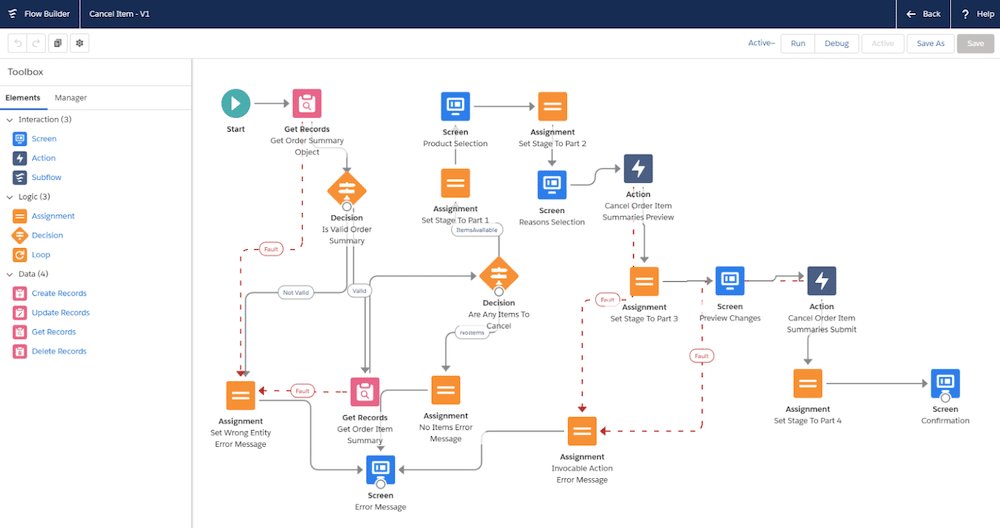
Input: Salesforce Flow Builder — Cancel Item V1
Salesforce Flow Builder · Cancel_Item_V1 · Active
Salesforce Flow Builder Cancel Item V1
Flow parsed via Salesforce adapter · 14 nodes extracted · 4 fault paths detected · 2 decision branches · 1 loop identified
Kernel output: 2 violations · 2 gaps
ViolationL1 · Conservation
Four fault paths have no defined resolution
The flow contains four dashed red fault paths none of which connect to a defined error handling terminal. A fault on any node leaves the cancellation in an indeterminate state. No retry, no rollback, no notification is defined.
ViolationL2 · Reachability
Set Wrong Entity Error Message is a dead-end branch
The assignment node is reached on invalid order summary but has no defined continuation path. The error state is set but never surfaced to the user or upstream system. The branch opens and never closes.
GapL4 · Data Satisfaction
Get Order Item Summary depends on prior Get Records
Get Order Item Summary reads data only valid if the preceding Get Order Summary Object succeeded. No explicit dependency is defined. If the first Get Records fails silently, the second node operates on absent data.
GapL5 · Evidence Integrity
Invocable Action Error Message has no audit record
The error assignment fires on action failure but no record of the failure, its cause, or the order state is written to any data store. Compliance review of failed cancellations has no provenance to examine.
Sign-Off RequiredDeployment requires human sign-off
2 violations · 2 gaps
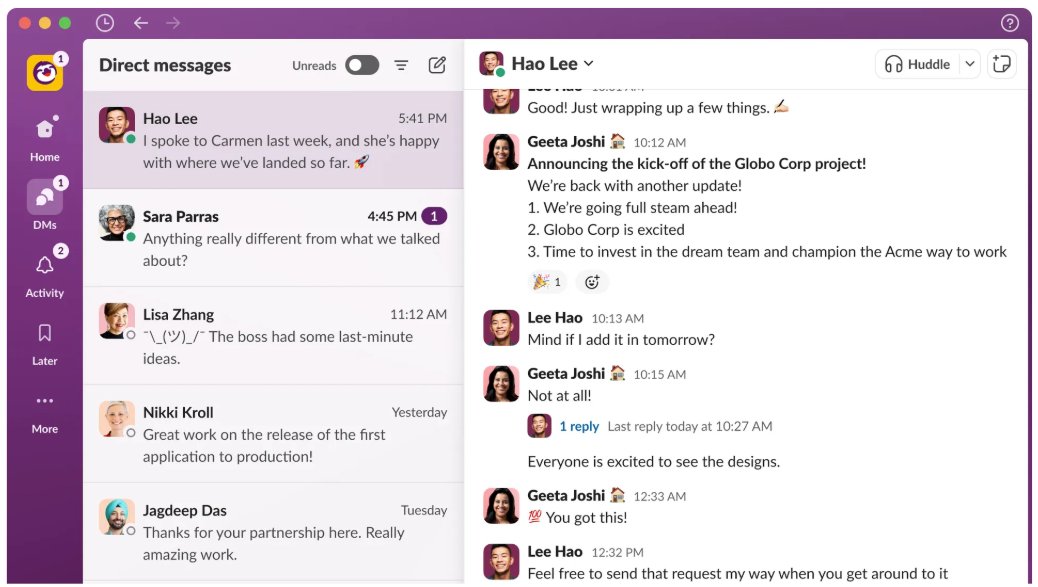
Input: Slack thread — direct messages and project channel
Slack · Direct Messages · 14 messages ingested
Slack conversation thread
14 messages parsed · 6 decision statements extracted · 3 contradictions detected · 1 undefined trigger identified
Kernel output: 2 violations · 2 gaps
ViolationL1 · Conservation
Legal trigger condition is contradictory
Marcus states legal review is required for enterprise account refunds. Jana states legal only reviews if a contract amendment is involved. Both apply to enterprise accounts but produce opposite outcomes. No deterministic path exists.
ViolationL3 · Membrane Discipline
CS override crosses authority boundary
CS Director confirms override authority for strategic accounts regardless of amount. This overrides the finance approval boundary for amounts above $1K. CS and finance authority domains intersect with no defined protocol.
GapL2 · Reachability
Strategic account classification undefined
CS override applies to strategic accounts but no rule defines what constitutes a strategic account, who classifies them, or when that classification is reviewed. The override condition has no reachable definition.
GapL5 · Evidence Integrity
Verbal agreement has no audit record
The approval structure was agreed in a Slack thread with no formal record, no version, and no designated owner. Any dispute about the approval structure has no authoritative source to reference.
Sign-Off RequiredDeployment requires human sign-off
2 violations · 2 gaps

Text, images, metadata, platform flows, conversations. The input format does not change the standard. The kernel applies the same six constitutional principles to every source. Every time.


Why Now

The race to execution
skipped the foundation.

"Every platform optimizes for faster execution. Nobody is asking what the execution is running on. The operational blueprint has been treated as a byproduct of technology choices for decades. Flowsiti makes it the governing force."

01
Flawed logic runs faster
Agents execute at the speed of automation. Every unvalidated rule in your blueprint runs at full scale from the moment of deployment. There is no human in the loop to catch it.
02
Vertical optimization produces systemic fragility
Each agent works correctly in its domain. When their unvalidated rules intersect across entities and systems, the failures are systemic, compounding, and untraceable.
03
Validated logic makes agents trustworthy
Flowsiti is not anti-agent. It is the foundation that makes agents safe to trust. AI amplifies validated logic. That is the only premise under which autonomous deployment is defensible at scale.
Connections — Platform Registry
Flowsiti Connections showing all platform integrations organized by category with role tags
Every platform Flowsiti connects to, organized by role: Source, Target, Intake, Operator, Service. CRM, ERP, IDEs, agents, automation tools. The blueprint governs all of them.
Deployments — Manifest Delivery
Flowsiti Deployments showing PR delivery to Salesforce and n8n with deployment history
Verified blueprint compiled and delivered as pull requests to Salesforce and n8n simultaneously. DevOps-native. Version-controlled. Traceable.

The Flowsiti Doctrine

The founding argument
for why this layer exists.

The Doctrine makes the structural case: why enterprise transformation has always failed at the same point, why the agent era makes the gap existential, and why the operational blueprint must be treated as a first-class citizen before any execution layer is trusted with it.

Written for architects, transformation leaders, and anyone who has inherited the consequences of logic that was never validated before it was deployed.

Request the Doctrine
From the Doctrine

"The gap between what organizations believe about themselves and what is actually true is the most expensive gap in enterprise software."

From the Doctrine

"Agents do not fix flawed business logic. They execute it, faster, at greater scale, with the appearance of intelligence that makes it nearly impossible to tell where the failure originated."

From the Doctrine

"The operational blueprint is not the output of technology decisions. It is the governing force that defines them."


Request a Session

Show us
what you have.
We will show
what breaks.

Bring your current operating rules, architecture decisions, or governance constraints, however incomplete. We will show exactly what is contradictory, what cannot scale, and what is ready to be formalized. Before anything is deployed that depends on it.

No product demonstration. No pitch. We start with your actual operating model.

Tell us about yourself

We will use this to confirm and prepare your session.

Primary challenge
Ongoing governance across entities
Agentic AI deployment
Platform transformation
Failed or stalled deployment
Scalability across complex tech stack
Other
Response within one business day.
check_circle

Request received.

We will be in touch within one business day to confirm and schedule your session.